


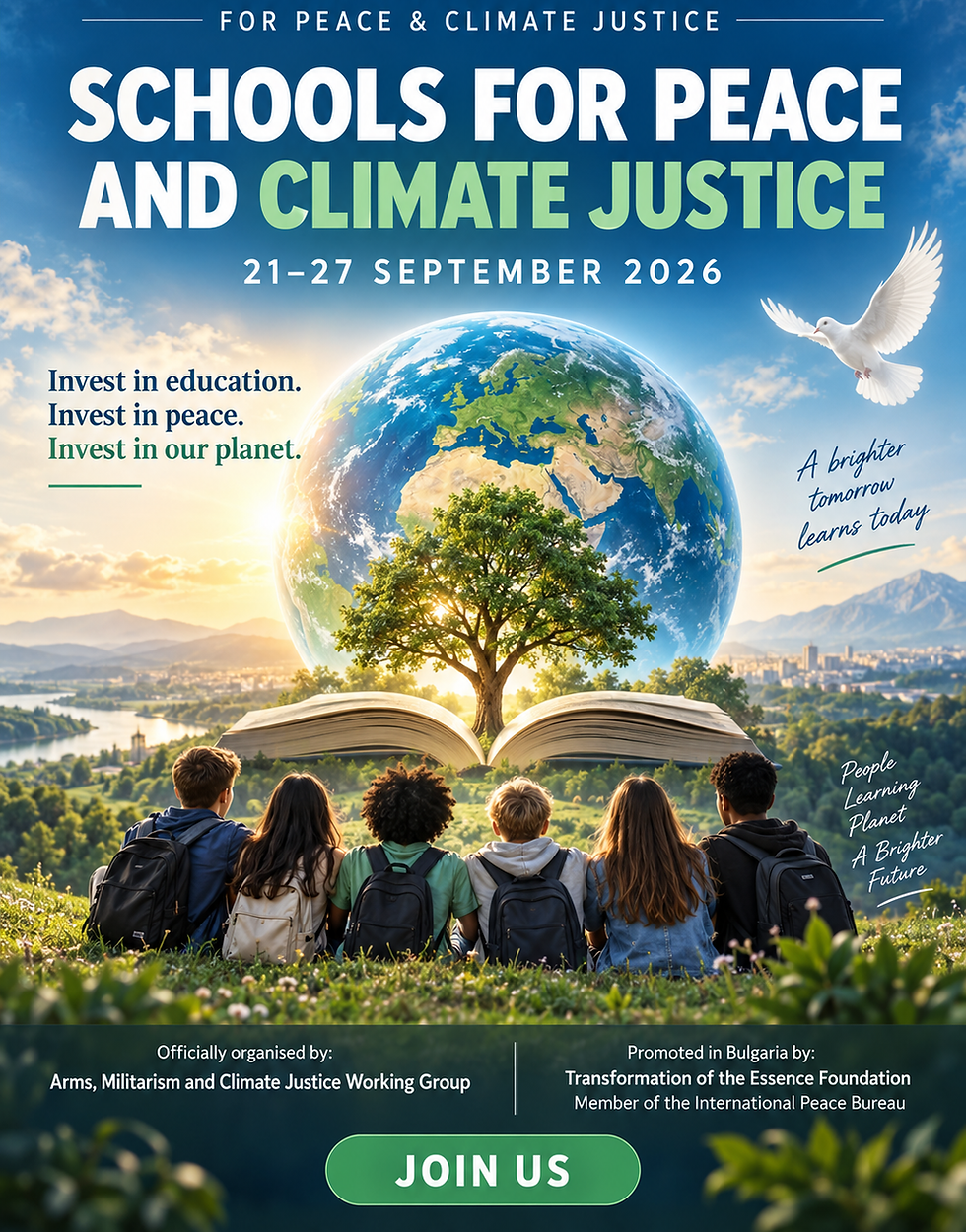
Schools for Peace and Climate Justice

Schools for Peace and Climate Justice
Part of the Global Week of Action for Peace and Climate Justice
21–27 September 2026
The Global Week of Action for Peace and Climate Justice is officially organised by the Arms, Militarism and Climate Justice Working Group, whose participating organisations include the International Peace Bureau (IPB), Peace Boat, Stop Wapenhandel, War Resisters’ International, Scientists for Global Responsibility, the Conflict and Environment Observatory, and the Transnational Institute.
In Bulgaria, the initiative is promoted by the Transformation of the Essence Foundation, a member organisation of the International Peace Bureau. The Foundation invites schools, students, teachers, parents, and local communities across the country to participate in the Global Week by organising educational, creative, environmental, and community-based activities dedicated to peace, human security, and climate justice.
Campaign period: 21–27 September 2026
International organiser: Arms, Militarism and Climate Justice Working Group
Promoted in Bulgaria by: Transformation of the Essence Foundation, member of the International Peace Bureau
Participants: Schools, students, teachers, parents, and local communities
Each school may choose one or more activities appropriate to the age of its students.
Voices and Actions for Peace and Climate Justice 2026
International Gallery of Participating Schools and Kindergartens
Let the World Dance: A Song and Dance for Peace
Ivan Sergeyevich Turgenev Primary School, Razgrad, Bulgaria
As part of the international educational initiative “Schools and Kindergartens for Peace and Climate Justice 2026”, the students of Class 4A at Ivan Sergeyevich Turgenev Primary School in Razgrad, Bulgaria, created an inspiring musical and dance performance entitled “Let the World Dance.”
The initiative was carried out during the Global Week of Action for Peace and Climate Justice, which brought together schools, organisations, and communities around the world through activities dedicated to peace, solidarity, human security, environmental responsibility, and climate justice.
About the Initiative
Title: Let the World Dance – A Song and Dance for Peace
Institution: Ivan Sergeyevich Turgenev Primary School
Location: Razgrad, Bulgaria
Date: 23 September 2026
School Principal: Milena Oreshkova
Activity Coordinator: Teodora Panagonova, Full-Day Education Teacher
Participants: 21 students and one teacher
Total number of participants: 22
All 21 students from Class 4A participated in the creative preparation, discussions, and decision-making process, while 12 students took part directly in the final video performance.
A Children’s Idea Brought to Life
The idea for the activity came from the students themselves. Inspired by their love of music and dance, they wanted to create something that would express their understanding of peace in a joyful, accessible, and meaningful way.
For the children, peace was not simply an abstract concept. They associated it with friendship, kindness, cooperation, mutual support, respect for others, and care for the Earth.
Together with their teacher, the students decided to create a musical and dance message dedicated to peace, friendship, solidarity, and responsibility for the planet. Their goal was to show that children can communicate important global values through creativity, movement, music, and teamwork.
Creativity and Technology Working Together
Contemporary artificial intelligence platforms were used as supportive tools during the creative process. With their assistance, different versions of the lyrics, music, rhythm, and overall sound were developed around the themes of peace and climate justice.
The students explored and discussed the available options. Their main criteria were whether the message was appropriate for children, whether the music created a positive emotional response, and whether the rhythm could be successfully interpreted through dance.
Following a shared discussion, the class selected the song “Let the World Dance” because it best reflected their vision of a joyful, positive, unifying, and danceable message for peace.
The use of artificial intelligence also offered the students a valuable opportunity to discover how modern technologies can be used responsibly to create positive and educational content.
Technology supported the process, but the children remained at its heart. The original idea, the choice of message, the discussion of the different versions, and the decision about how the song would be presented all resulted from the collective work of the class.
Creating the Dance
After selecting the song, the students began developing their dance performance.
Because dancing is one of their greatest passions, they approached the task with enthusiasm and imagination. Every participant was encouraged to suggest movements, contribute ideas, and help shape the choreography.
The preparation became more than an artistic activity. It developed into a practical lesson in cooperation, patience, shared responsibility, mutual respect, and teamwork.
The children listened to one another, discussed different ideas, made decisions together, and supported their classmates. In this way, the creative process itself reflected the values that the initiative sought to promote.
It demonstrated that a culture of peace is built not only through words, but also through everyday actions: listening, respecting different opinions, helping one another, and working together towards a shared goal.
The Message of the Performance
The final result was a dance performance created for the song “Let the World Dance” and recorded on video.
Through their music and choreography, the students shared a positive message with their classmates, teachers, parents, and people around the world:
“Hand in hand, heart to heart, peace begins with what we start. Together, we can make the world a better place!”
The song also presents the Earth as humanity’s shared home and reminds listeners of the responsibility to protect it.
By connecting peace, positive human relationships, and care for nature, the children showed that climate justice and peace are not separate ideas. Both depend on cooperation, responsibility, empathy, and the ability to think beyond individual interests.
One Planet, One Home
The message chosen by Class 4A is:
One planet – one home.
One heart – one team.
One smile – one dream.
Peace and kindness for the world!
Through this message, the students expressed their belief that people can create something meaningful and beautiful when they unite around a positive idea.
Their performance reminds us that every child has a voice and that this voice can contribute to a more peaceful, compassionate, and sustainable world.
Educational Impact
Participation in the initiative gave the students an opportunity to express their understanding of peace through a combination of:
-
music and dance;
-
creativity and imagination;
-
responsible use of modern technology;
-
discussion and shared decision-making;
-
cooperation and teamwork;
-
environmental awareness;
-
respect for other people’s ideas.
The activity helped transform the concept of peace into a real and memorable experience. For the students, peace became connected with friendship, smiles, mutual support, respect, cooperation, and care for the planet.
The project also demonstrated how artificial intelligence can be incorporated into education as a creative supporting tool while preserving the leading role of children’s ideas, choices, imagination, and active participation.
Most importantly, the students did not simply perform a prepared song. They participated in the entire process: developing the idea, selecting the message, discussing the creative options, designing the choreography, and presenting the final performance.
A Message Beyond the Classroom
“Let the World Dance” carries a message that reaches beyond one classroom and one school.
It shows that peace education can be engaging, joyful, contemporary, and closely connected to children’s interests. It also demonstrates that young people do not have to wait until adulthood to contribute to positive change.
Through their song and dance, the students of Class 4A proved that when children are trusted, listened to, and encouraged to create together, they can transform important values into powerful messages.
Their conclusion is simple and universal:
When we are together, we can create, dream, and change the world for the better.
Watch the Performance
The video performance “Let the World Dance” is available here:
Watch “Let the World Dance” on YouTube
Let the world dance. Let peace begin with us.
 |
|---|
 |
 |


Active Sport at School: Sport, Peace, and Care for the Planet
Ivan Sergeyevich Turgenev Primary School, Razgrad, Bulgaria
More than 250 children, teachers, parents, and members of the school community at Ivan Sergeyevich Turgenev Primary School in Razgrad, Bulgaria, came together for a joyful sports celebration dedicated to physical activity, fair play, peace, cooperation, and care for the planet.
The event, entitled “Active Sport at School: Sport, Peace, and Care for the Planet,” was organised as part of the international educational initiative “Schools and Kindergartens for Peace and Climate Justice 2026” and the Global Week of Action for Peace and Climate Justice.
It also marked the European School Sport Day, connecting physical activity with important values such as mutual support, respect, teamwork, environmental responsibility, and peaceful coexistence.
About the Initiative
Title: Active Sport at School: Sport, Peace, and Care for the Planet
Institution: Ivan Sergeyevich Turgenev Primary School
Location: Razgrad, Bulgaria
Date: 25 September 2026
Venue: School playground
School Principal: Milena Oreshkova
Activity Coordinator: Ivelina Bozhkova, Sports Teacher
Children and students: 206
Total participation: More than 250 children, teachers, parents, and supporters
The activity was organised under the programme area “Sport and Community.”
A Celebration of Movement and Shared Values
The sports celebration brought together the school’s preparatory group and all students from Grades 1 to 4.
The event began with a short address about the importance of physical activity, fair play, mutual respect, and protecting humanity’s shared home – the Earth.
The children were reminded that sport is not only about winning. It is also about learning to follow rules, respect others, support teammates, accept differences, and work towards a common goal.
These values are closely connected to a culture of peace. On the sports field, as in everyday life, peaceful cooperation begins with fairness, responsibility, and respect.
Moving Together
Following the opening message, all participants joined a lively musical warm-up.
The children then took part in relay races and movement games using cones, hoops, balls, and different obstacle courses. The activities were designed to encourage active participation, coordination, teamwork, mutual support, and enjoyment.
Students competed in teams, but the emphasis remained on cooperation rather than rivalry. They encouraged one another, helped their classmates, followed the rules, and demonstrated respect for the other teams.
The preparatory group and every class from Grades 1 to 4 participated:
-
Preparatory Group – 16 children;
-
Class 1A – 21 students;
-
Class 1B – 21 students;
-
Class 2A – 25 students;
-
Class 2B – 22 students;
-
Class 3A – 23 students;
-
Class 3B – 17 students;
-
Class 4A – 21 students;
-
Class 4B – 22 students;
-
Class 4C – 18 students.
A total of 206 children and students took an active part in the sporting activities. Teachers, colleagues, and parents attended the celebration as supporters and members of the audience, bringing the total number of participants and guests to more than 250.
Fair Play as Education for Peace
Throughout the event, the children demonstrated that sport can be a powerful form of education for peace.
They learned that fair play means more than following the rules of a game. It also means treating others with dignity, accepting both success and disappointment, helping those who need support, and understanding that every participant is important.
The team activities encouraged the children to communicate, cooperate, and take shared responsibility. The games created an environment in which students could experience the values of peace through movement and direct interaction.
Instead of discussing cooperation only as an abstract idea, the children practised it on the school playground.
The Earth Is Our Greatest Playing Field
The environmental message of the celebration connected care for the school grounds with care for the planet.
The participants reflected on the idea that every playground, schoolyard, park, forest, and natural space is part of humanity’s shared home. Keeping these places clean and protected is a responsibility shared by everyone.
The central message of the participants was:
“We play fairly, help one another, and protect our playing field – because our greatest playing field is the Earth. Active sport at school – every day!”
The children also made a shared promise:
“We promise to stay active every day and care for the planet as our common home.”
Through this message, the students connected healthy living with environmental responsibility. They showed that caring for ourselves, caring for other people, and caring for the Earth are all part of the same commitment to a peaceful and sustainable future.
A Celebration for the Whole School Community
The sports day concluded with a special presentation ceremony.
Each class and the preparatory group received a new ball accompanied by a message encouraging continued physical activity, cooperation, and fair play. The gifts included footballs, volleyballs, basketballs, and dodgeballs.
The celebration continued with music, dancing, and a traditional Bulgarian horo, in which children, teachers, and other members of the school community joined together.
The shared dance became a powerful symbol of unity. Every participant was part of the same circle, moving together and contributing to the spirit of the celebration.
Results and Educational Impact
The activity successfully combined sport, peace education, community participation, and environmental awareness.
It encouraged the children to:
-
be physically active;
-
practise fair play;
-
respect rules and other participants;
-
cooperate within a team;
-
support their classmates;
-
take responsibility for shared spaces;
-
understand the Earth as humanity’s common home;
-
connect personal wellbeing with care for the environment.
The event demonstrated that sport can bring an entire school community together around positive values. It also showed that peace education can take place not only in the classroom, but also through movement, games, teamwork, music, and shared celebration.
A Message Beyond the School Playground
Through “Active Sport at School,” the children of Ivan Sergeyevich Turgenev Primary School showed that peace begins in everyday behaviour.
It begins when children play fairly, help one another, respect their teammates, protect their surroundings, and recognise that everyone belongs to the same community.
Their sports celebration carried a simple but powerful message:
Be active. Play fairly. Help one another. Protect the Earth.
By bringing together more than 250 members of the school community, the initiative transformed the school playground into a space for movement, friendship, cooperation, and hope.
It reminded everyone that our greatest shared field is the planet itself – and that protecting it is a responsibility we all share.
 |  |
|---|---|
 |  |
The Dove of Kindness: When Kindness Takes Flight
Ivan Sergeyevich Turgenev Primary School, Razgrad, Bulgaria
To mark the International Day of Peace, the students of Class 1A at Ivan Sergeyevich Turgenev Primary School in Razgrad, Bulgaria, took part in a special creative activity dedicated to kindness, friendship, unity, and peace.
The initiative, entitled “The Dove of Kindness: When Kindness Takes Flight,” was organised as part of the international educational initiative “Schools and Kindergartens for Peace and Climate Justice 2026.”
It was carried out under Programme Area 1, “Messages and Creativity,” as part of the activity “One Message for Peace.”
Twenty-One Children, Twenty-One Feathers, Twenty-One Messages
The activity brought together 21 first-grade students.
Each child received a paper feather containing a short message about kindness, friendship, respect, or peace. The students first traced the words along dotted lines and then coloured and decorated their feathers in their own individual way.
Every feather became unique, reflecting the imagination, emotions, and personal choices of its young creator.
As the children worked, they discussed the meaning of the words written on their feathers. They talked about how kindness can be expressed not only through words, but also through actions.
The students shared examples of simple ways to show kindness in everyday life:
-
helping someone who needs support;
-
offering a smile;
-
listening to another person;
-
showing respect;
-
sharing with others;
-
caring for a classmate;
-
using gentle and encouraging words;
-
protecting people, animals, and nature.
Through this conversation, the children discovered that even the smallest positive action can influence another person and help create a more peaceful environment.
Creating the Dove Together
At the beginning of the activity, the dove’s wings were empty.
One by one, the children added their decorated feathers. Gradually, the empty wings became filled with colours, messages, and wishes for a kinder and more peaceful world.
Each feather was beautiful on its own, but when all 21 feathers were placed together, they became something larger and more meaningful – the shared Dove of Kindness of Class 1A.
The completed dove became a symbol of:
-
unity;
-
friendship;
-
shared values;
-
mutual respect;
-
cooperation;
-
hope;
-
peace.
The creative process helped the children understand that every person has something valuable to contribute. Just as the dove needed every feather to complete its wings, a peaceful community needs the kindness and participation of every individual.
Peace Begins with Us
The activity encouraged the students to see peace as something that begins in their own classroom and in their everyday relationships.
For the children, peace became connected with helping, smiling, sharing, respecting others, resolving disagreements calmly, and caring for those around them.
They learned that peace is not only a global goal or an idea discussed by adults. It is also present in the small choices people make every day.
A kind word can prevent sadness.
A helping hand can give someone courage.
A smile can make another person feel accepted.
An act of care can inspire another act of care.
Through these simple examples, the students discovered that they already have the ability to contribute to peace.
Learning Through Creativity
“The Dove of Kindness” combined literacy, art, emotional learning, and peace education in one meaningful classroom experience.
By tracing the messages, the first-grade students practised their early writing skills. By decorating the feathers, they expressed their creativity and individuality. By discussing kindness and peace, they developed empathy, emotional awareness, and respect for others.
The activity also strengthened the children’s ability to work towards a shared goal. Although each student created an individual feather, the final artwork could only be completed when all the contributions were brought together.
The process showed the children that individuality and community are not opposites. Every child can be different while still being an important part of the same class, the same school, and the same human family.
The Message of Class 1A
The central message of the initiative was:
Peace begins with us and depends on every one of us.
The children demonstrated that kindness does not need to be a grand gesture. It can begin with a small action, a thoughtful word, a moment of patience, or a willingness to help.
When these small actions come together, they create something powerful and beautiful.
The students expressed this idea through the symbolic message:
Every act of kindness is a small feather. Together, we can give kindness wings.
Educational Impact
Through their participation, the children:
-
explored the meaning of kindness, friendship, and peace;
-
practised expressing positive messages;
-
connected words with real actions;
-
developed creativity and fine motor skills;
-
learned to value the contribution of every classmate;
-
worked together to create a shared symbol;
-
discovered that they can actively contribute to a peaceful community.
The initiative transformed an abstract idea into a visual and memorable experience. The completed dove became more than a classroom decoration. It became a shared promise to treat others with kindness, respect, and care.
When Kindness Takes Flight
The Dove of Kindness created by Class 1A reminds us that peace is built through everyday human relationships.
Each child contributed one feather. Each feather carried one message. Together, they gave the dove its wings.
In the same way, every act of kindness contributes to a more peaceful world.
One small action may appear insignificant, but when kindness is shared by many people, it grows, spreads, and takes flight.
Twenty-one children. Twenty-one feathers. Twenty-one messages. One shared Dove of Kindness.
Schools for Peace and Climate Justice
Period: 21–27 September 2026
Organiser: Transformation of the Essence Foundation
Participants: Schools, students, teachers, parents, and local communities
Each school may choose one or more activities appropriate to the age of its students.
1. “One Message for Peace”
Suitable for: Grades 1–7
Each student writes a short message on a paper leaf, dove, heart, or water droplet:
-
“To me, peace means…”
-
“To protect our planet, we must…”
-
“I feel safe when…”
-
“I can help others by…”
The messages can be arranged to create:
-
a Tree of Peace;
-
a Wall of Kindness;
-
a Planet of Peace;
-
a map of Bulgaria made from students’ messages.
At the end of the activity, each school sends the Foundation a photograph of its completed display.
2. “One Lesson for Peace and the Planet”
Suitable for: All age groups
Classes hold a special class meeting or an interdisciplinary lesson exploring topics such as:
-
How are peace and environmental protection connected?
-
What does human security mean?
-
How do climate-related disasters affect children and families?
-
How can dialogue prevent conflict?
-
Why are clean water, food, education, and healthcare essential conditions for peace?
The lesson may conclude with one collective class decision: What will we do over the next month to create a more peaceful and sustainable school environment?
3. “Parliament of the Future”
Suitable for: Grades 5–12
Students are given a hypothetical public budget of 100 points. They must allocate it among the following areas:
-
education;
-
healthcare;
-
disaster preparedness and protection;
-
climate adaptation;
-
social support;
-
security;
-
culture and sport;
-
scientific research.
Each group presents and defends its decisions. The purpose is not to create a single “correct” budget, but to help students understand that public decisions have consequences and require careful balance.
This activity communicates the international message “Invest in a Just Transition” while keeping the school environment educational and non-partisan.
4. Student Challenge: “100 Ideas for Peace”
Each school collects practical proposals from its students in response to the question:
“How can we make our school, community, or planet more peaceful, just, and sustainable?”
Ideas may focus on:
-
preventing aggression and bullying;
-
conserving water and energy;
-
supporting vulnerable children;
-
creating greener school spaces;
-
volunteering;
-
resolving disputes peacefully;
-
improving preparedness for natural disasters.
The best proposals may be collected in a digital publication entitled:
“Young Voices: 100 Ideas for Peace and the Future”
5. “Green Pathway to Peace”
A practical school-based initiative that may include:
-
planting a tree or flowers;
-
creating a “Peace Garden”;
-
cleaning a school or community space;
-
making birdhouses;
-
organising a separate waste collection campaign;
-
holding a plastic-free day;
-
exchanging books and educational materials.
Each planted tree or flower may carry a message such as “Dignity,” “Dialogue,” “Justice,” “Hope,” or “Solidarity.”
6. “Peace and the Planet Through My Eyes” Competition
Possible categories include:
-
drawing;
-
photography;
-
essay;
-
poem;
-
short story;
-
poster;
-
short video of up to 60 seconds;
-
digital project;
-
school podcast.
Age groups:
-
Grades 1–4;
-
Grades 5–7;
-
Grades 8–10;
-
Grades 11–12.
The best works may be published on the Foundation’s website and in a special edition of The Living Genesis.
7. “A Message to the Leaders of 2030”
Students write a short letter beginning with the words:
“If I could speak to the people making decisions about the future of our world, I would tell them…”
The letters may be used to create a joint Students’ Declaration for Peace, Human Security and Climate Justice, which can be translated into English and submitted to the International Peace Bureau.
8. “School Mediators for a Day”
Students consider fictional conflict situations, such as:
-
a disagreement between classmates;
-
the exclusion of a child from a group;
-
aggressive behaviour online;
-
a conflict over a shared school resource;
-
a confrontation between two groups.
They must find a solution through active listening, mediation, and compromise. In this way, the global theme of peace is transformed into a practical life skill.
9. “One Minute of Silence — One Minute of Commitment”
On a designated day, all participating schools may simultaneously:
-
Observe one minute of silence for children affected by war, violence, and climate-related disasters.
-
Read a shared message of peace.
-
Invite each class to formulate one commitment to action.
When students participate, schools should use neutral, humanitarian language without political slogans or images that could cause distress or trauma.
10. “A Kilometre for Peace”
A sports and charity initiative that may include:
-
a symbolic walk or run;
-
a cycling event;
-
a hiking route;
-
a school relay race;
-
a collective dance or sports festival.
Each class represents a cause, such as access to clean water, access to education, disaster relief, the prevention of violence, or environmental protection.




PARTICIPATION GUIDELINES
“Schools and Kindergartens for Peace and Climate Justice”
A National Educational Initiative as Part of the Global Week of Action for Peace and Climate Justice
Campaign period: 21–27 September 2026
The Global Week of Action for Peace and Climate Justice is organised by the Arms, Militarism and Climate Justice Working Group, which includes the International Peace Bureau (IPB), Peace Boat, War Resisters’ International, Scientists for Global Responsibility, and other international organisations.
In Bulgaria, the initiative is promoted by the Transformation of the Essence Foundation, a member organisation of the International Peace Bureau.
1. Objectives of the Initiative
The initiative aims to:
-
promote a culture of peace, dialogue, and non-violent conflict resolution;
-
foster children’s and students’ sense of responsibility towards nature and their communities;
-
demonstrate the connection between peace, human security, and climate justice;
-
encourage the active participation of children and young people;
-
promote volunteering, solidarity, and care for others;
-
unite kindergartens, schools, families, and local communities around shared positive causes.
The initiative is educational and humanitarian in nature. Political campaigning, party-political slogans, hate speech, and images that may cause fear or distress among children are not permitted.
2. Who May Participate
Participation is open to:
-
public, municipal, and private kindergartens;
-
public, municipal, and private schools;
-
centres for personal development support;
-
centres for special educational support;
-
student councils, clubs, and volunteer groups;
-
individual groups, classes, or year groups;
-
teachers, education professionals, and school psychologists;
-
parents and representatives of local communities.
Participation is voluntary and free of charge.
3. Ways to Participate
Each institution may choose one or more of the suggested activities or organise its own initiative related to peace, human security, solidarity, and climate justice.
Strand 1: Messages and Creativity
-
“One Message for Peace”;
-
a Tree of Peace;
-
a Wall of Kindness;
-
a Planet of Peace;
-
an exhibition entitled “Peace and the Planet Through My Eyes”;
-
a drawing, poster, photograph, essay, poem, or short story;
-
a short video of up to 60 seconds;
-
a school podcast or digital project;
-
a song, theatre performance, or dance dedicated to peace.
Strand 2: Education and Dialogue
-
“One Lesson for Peace and the Planet”;
-
a themed educational activity in kindergarten;
-
an interdisciplinary lesson;
-
a discussion on human security;
-
a “Parliament of the Future”;
-
a meeting with a volunteer, environmentalist, mediator, or representative of a civil society organisation;
-
reading and discussing an age-appropriate story or literary work;
-
a student conference or round-table discussion.
Strand 3: Acts of Kindness and Care for Nature
-
planting a tree or flowers;
-
creating a “Peace Garden”;
-
cleaning a school, community, or natural area;
-
organising a separate waste collection campaign;
-
holding a plastic-free day;
-
making birdhouses or bird feeders;
-
exchanging books, toys, or educational materials;
-
conducting a volunteer or charitable activity;
-
supporting a child, family, or vulnerable group.
Strand 4: Participation of Children and Young People
-
the “100 Ideas for Peace” challenge;
-
“A Message to the Leaders of 2030”;
-
a student declaration for peace and climate justice;
-
“School Mediators for a Day”;
-
proposals for creating a calmer, safer, and more sustainable educational environment;
-
a student survey or questionnaire;
-
an initiative led by the student council.
Strand 5: Sport and Community
-
“A Kilometre for Peace”;
-
a symbolic walk or run;
-
a cycling event or hiking route;
-
a school relay race;
-
a group dance or sports celebration;
-
a family environmental activity;
-
a peace festival involving parents and the local community.
4. Activities Suitable for Kindergartens
Kindergartens may organise:
-
a Tree of Kindness featuring drawings and children’s messages;
-
a collaborative drawing entitled “Our Peaceful Planet”;
-
the planting of a flower or tree;
-
a Friendship Day;
-
a story and discussion about kindness, sharing, and helping one another;
-
cooperative games;
-
an art exhibition;
-
a symbolic walk for peace;
-
a song or dance celebrating friendship;
-
the creation of paper doves, hearts, leaves, or flowers.
When working with preschool children, the theme should be presented through positive concepts such as friendship, kindness, care, mutual support, and protecting nature, without images or stories depicting war or violence.
5. Stages of Participation
Stage One: Registration
Each institution should complete a short online registration form by 20 September 2026.
The registration form should include:
-
the full name of the institution;
-
town or city and administrative region;
-
the name of the headteacher or director;
-
the name and position of the institutional coordinator;
-
a telephone number and email address;
-
the selected activity or activities;
-
the estimated number of participants;
-
the participating age group;
-
confirmation that the institution agrees to comply with these Participation Guidelines.
Registration may also be completed during the Global Week, but no later than 27 September 2026.
Stage Two: Implementation of Activities
Activities should take place between 21 and 27 September 2026.
Where necessary, a school or kindergarten may hold its activity on the nearest suitable school day, provided that the actual date is stated in the final report.
Stage Three: Submission of the Activity Report
Reports must be submitted by 5 October 2026 through an online reporting form or to the official email address announced by the Transformation of the Essence Foundation.
6. Required Content of the Activity Report
Each participating institution should provide:
-
The full name of the institution.
-
Town or city and administrative region.
-
The name of the headteacher or director.
-
The name and position of the institutional coordinator.
-
The title and a brief description of the activity — up to 1,500 characters.
-
The date and location of the activity.
-
The number of participating children, students, teachers, and parents.
-
Between one and five photographs.
-
Where applicable, a link to a video, publication, school website, or online photo album.
-
One brief outcome of the activity — a message, idea, commitment, declaration, or proposal created by the participants.
-
Consent for the submitted materials to be used to document and promote the initiative.
It is not necessary to submit every drawing or creative work produced by the children and students. Selected examples or a photograph of the complete exhibition are sufficient.
7. Technical Requirements
-
Photographs must be submitted in JPG or PNG format.
-
The recommended maximum size of each file is 10 MB.
-
Written materials must be submitted in DOCX or PDF format.
-
Videos should not be attached to emails; an accessible link should be provided instead.
-
A maximum of five photographs may be submitted.
-
All materials must be legible and clearly labelled.
Recommended file-naming format:
Town_Institution_Activity
Example:
Razgrad_Ivan-Turgenev-School_Tree-of-Peace.jpg
When submitting materials by email, the subject line should read:
Participation – Schools and Kindergartens for Peace – [Name of Institution]
8. Protection of Personal Data and Images of Children
Each participating educational institution is responsible for:
-
obtaining the necessary informed consent from parents or legal guardians for children to be photographed and their images to be published;
-
refraining from submitting children’s personal data, except for a first name and age where explicit consent has been obtained;
-
ensuring that no sensitive information is published;
-
refraining from submitting images of children for whom permission for public presentation has not been obtained.
Where consent to publish recognisable images of children has not been obtained, institutions may submit photographs:
-
of the children’s creative work and displays;
-
showing children from behind;
-
showing only hands during an activity;
-
of the shared activity space;
-
of the activity without identifiable faces.
The Foundation may use the submitted materials solely to present, document, and promote the initiative.
9. Awards and Recognition
The initiative is non-competitive. Every institution that completes at least one eligible activity and submits a complete report within the specified deadline will receive formal recognition.
Recognition for Kindergartens and Schools
Every approved participating institution will receive:
-
an official “School for Peace and Climate Justice 2026” or “Kindergarten for Peace and Climate Justice 2026” commemorative plaque;
-
an official Certificate of Participation issued by the Transformation of the Essence Foundation;
-
inclusion in the national list of participating educational institutions;
-
the opportunity for its activity to be featured on the Foundation’s website and in a special edition of The Living Genesis.
Each institution will receive one official plaque, regardless of the number of activities it conducts.
Recognition for Headteachers, Directors, and Coordinators
-
The headteacher or director will receive a personalised certificate recognising their institutional support.
-
The officially designated coordinator will receive a personalised certificate recognising their contribution to education for peace and climate justice.
-
If more than one coordinator is involved, the institution should provide their names in the final report.
Recognition for Teachers and Education Professionals
Every teacher or education professional directly involved in preparing and implementing an activity may receive a personalised digital certificate.
The names of eligible staff members must be submitted by the headteacher, director, or official institutional coordinator.
Recognition for Children and Students
Every participating class, kindergarten group, club, or student team will receive a digital Certificate of Participation.
Individual digital certificates may also be issued to participating children and students where their names have been provided by the institution in compliance with applicable personal-data protection requirements.
It is recommended that certificates for younger participants be printed and presented ceremonially by their kindergarten or school.
10. Eligibility for Plaques and Certificates
An institution will be eligible for recognition if it:
-
has registered its participation;
-
has conducted at least one relevant activity;
-
has submitted its report by the specified deadline;
-
has provided an accurate number of participants;
-
has complied with personal-data protection requirements;
-
has not used political campaigning, hate speech, or content unsuitable for children.
Registration alone, without the completion and reporting of an activity, does not entitle an institution to receive a plaque or certificate.
11. Special Recognition Awards
The organiser may present additional honorary awards in the following categories:
-
“Most Inspiring Message for Peace”;
-
“Most Active School Community”;
-
“Outstanding Kindergarten Initiative”;
-
“Outstanding Student-Led Initiative”;
-
“Outstanding Environmental Activity”;
-
“Outstanding Local Community Engagement”;
-
“Innovation in Peace Education”;
-
“Young Ambassador for Peace and Climate Justice”.
These special recognitions do not alter the non-competitive nature of the initiative and are not intended to create rivalry among participants. Their purpose is to highlight good practices that may be adopted by other educational institutions.
12. Presentation of Results
Following the conclusion of the initiative, the Transformation of the Essence Foundation will prepare a summary including:
-
the number of participating kindergartens and schools;
-
the number of participating children, students, teachers, and parents;
-
a map of participating towns and cities;
-
selected photographs and examples of good practice;
-
messages and proposals created by children and students;
-
a joint declaration for peace, human security, and climate justice.
The results may be presented to the International Peace Bureau and the partner organisations involved in the Global Week of Action for Peace and Climate Justice.
13. Important Dates
-
By 20 September 2026 — recommended advance registration;
-
21–27 September 2026 — implementation of activities;
-
By 5 October 2026 — submission of activity reports;
-
By 31 October 2026 — publication of results and distribution of digital certificates;
-
By 30 November 2026 — dispatch or presentation of commemorative plaques.
14. Contact Information
Transformation of the Essence Foundation
Member of the International Peace Bureau
Email: foundation.transformation24@gmail.com
Website: https://www.foundation-transformation.org/about-4-4


Join us
Registration is quick and easy.


